A visitor doesn't walk into a museum with an unlimited supply of attention. An audio guide competes for it with the exhibit itself, with the rest of the group, with fatigue after the first hour of walking — and it loses that competition far more often than most people assume.
I've been recording audio guides and audio description for museums, castles and cultural institutions for years, so I see up close what separates a track people listen to all the way through from one they switch off after three stops. The difference is rarely the recording budget. It is the script structure and how the voice guides attention. And that happens to be well documented in visitor-behaviour research.
Museum fatigue is real (and predictable)
Stephen Bitgood, one of the most cited researchers of visitor behaviour, reviewed the literature on so-called "museum fatigue" and showed that the drop in attention during a visit isn't random — it follows a repeatable, predictable pattern. Among the causes he lists are information overload, satiation from repeated exposure to similar stimuli, and the limited attention capacity a visitor has to split between exhibits, labels, conversation with the group, and their own tiredness.
For anyone building an audio guide, the takeaway is simple: a track that assumes 45 minutes of unbroken focus is designed against how attention actually behaves in a museum. A good script accounts for that from the start — it varies pace, stop length, and what's essential versus optional.
Design not for an ideally focused listener, but for someone who is looking, walking, talking and simply getting tired at the same time.
Why description guides the eye more effectively than silence
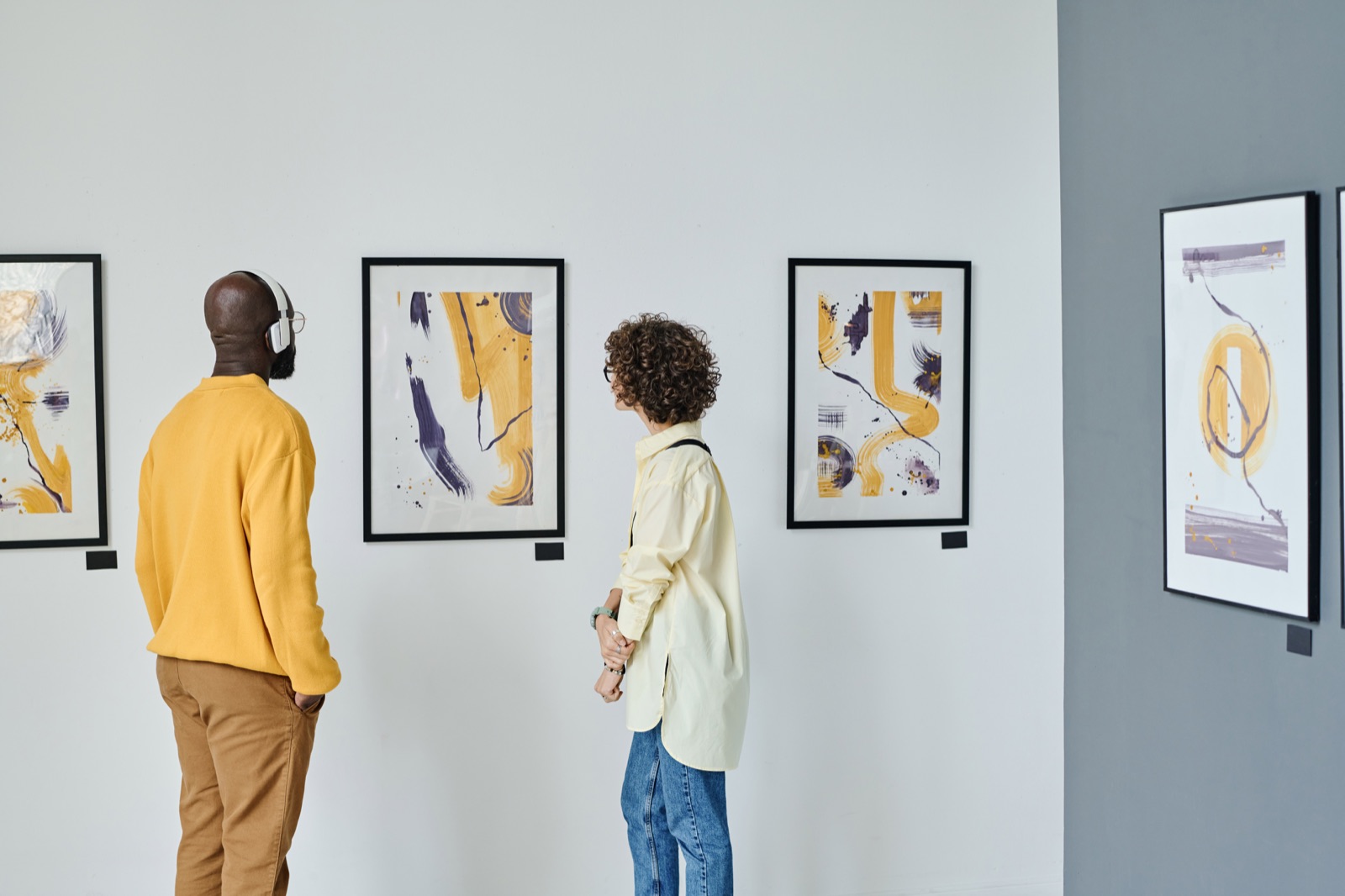
You might assume the best way to experience a work of art is silence — nothing pulling attention away from the object itself. Research by Rachel Hutchinson and Alison F. Eardley points the other way. They looked at how audio description — a spoken account of what's visible — affects memory of artworks, not only for blind visitors, for whom it was originally designed, but for sighted visitors too.
The result: guided "looking" through description improved sighted visitors' recall of the artworks. A voice that tells you what to look at, and in what order, reduces cognitive load instead of adding distraction — because the visitor no longer has to decide alone where to start. That's the opposite of the common assumption that narration gets in the way of engaging with an exhibit.

Anatomy of a good stop: hook, description, meaning, detail, prompt
In practice, that means a specific structure for each stop rather than free-form storytelling. A proven pattern has five consecutive elements:
A question, surprising fact or detail that explains why it is worth stopping right here.
A clear cue telling the visitor what they are looking at and where its key element is located.
An explanation of why the object, event or story being presented genuinely matters.
One memorable fact the visitor will not find on the information panel.
A natural close to the stop and a gentle direction towards the next point on the route.
In recordings I've made for institutions including the Royal Castle in Warsaw and the Crown Treasury at Wawel, this structure consistently outperforms a long, "encyclopaedic" description — even when there's far more historical material available. A visitor doesn't need everything the curator knows. They need whatever will make them remember this one object.
Script pace vs. walking pace
One last element rarely gets as much attention as content: pacing. A stop that reads well on paper but is recorded at a pace mismatched to how people actually move still loses. A family with a child moves differently from a solo visitor touring in silence, and an organised group moves differently from someone returning to the same spot a second time.
In practice, that means leaving room to breathe in the recording — pauses where a visitor can actually look at the object before the next sentence arrives — and avoiding sentences that would need to be replayed to be understood. If a sentence is hard to say out loud, it is probably hard to hear too.
How to write an audio-guide script step by step
- Start with the audience, purpose and route. Establish who will be listening, in what situation and which stops carry the main story. A family trail, specialist collection and QR-code city route each need a different narrative.
- Give each stop a clear pattern. Open with a question, fact or detail, then orient the visitor, explain why the object matters and guide the listener naturally towards the next point.
- Write for the ear, not the page. Use shorter sentences, clear subjects and information presented in the order the visitor sees it. Collect difficult names and foreign words in a pronunciation guide.
- Plan pauses and pace. Mark moments for looking, turning and walking towards the next case. A pause is part of the narration, not empty space that should automatically be removed.
How to prepare the script for recording and post-production
The studio should receive a factually approved script with unambiguous stop numbers and clearly separated language versions. Include pronunciation notes, the target app or playback system and any file specification supplied by the technology provider. Agreeing these details before the session reduces pickups and file-naming mistakes later.
Production rule: one approved script enters the studio. Any later script change may require a pickup, another edit and a fresh file export.
The production workflow covers a tone sample, recording, editing, removal of unwanted breaths and mouth clicks, mastering, normalization to the supplied specification and delivery as clearly named files. Before publication, the institution should listen through the entire route and verify numbering, filenames and spatial directions. It is also worth agreeing in advance which corrections belong to the recording process and which result from later changes to an approved script.
What to send for a recording quote
- the approved script or a representative excerpt,
- the number of stops and planned language versions,
- the audience and publishing context,
- the target app, device or QR-code setup,
- the required format, naming convention and technical specification,
- the publication deadline and intended licence scope.
What this means in practice
For a museum, castle or trail planning an audio guide recording, the conclusion is simple: a good script and well-paced delivery are not decoration on top of the historical content — they are the condition for that content actually reaching the visitor. On why a human voice matters specifically for audio description, not just correct pronunciation, see Human Voice or Synthetic Speech?.
References
- Stephen C. Bitgood, Museum Fatigue: A Critical Review, Visitor Studies, 2009, vol. 12, no. 2, pp. 93–111, doi.org/10.1080/10645570903203406 (accessed: July 27, 2026).
- Rachel Hutchinson, Alison F. Eardley, Inclusive museum audio guides: "guided looking" through audio description enhances memorability of artworks for sighted audiences, Museum Management and Curatorship, 2021, vol. 36, no. 4, pp. 427–446, doi.org/10.1080/09647775.2021.1891563 (accessed: July 27, 2026).
- Pathoura, How to Write a Museum Audio Guide Script That Engages Visitors, pathoura.com (accessed: July 27, 2026).